Copyright & publishing
Can You Sell AI-Assisted Books? Copyright, Images, and Publishing Rights
A practical U.S. guide to selling AI-assisted books, protecting your original work, licensing illustrations, adapting existing books, and meeting Amazon KDP disclosure rules.
Yes—you can publish and sell a book made with AI assistance in the United States. Using AI is not, by itself, a ban on commercial publication. But three different questions still matter: what you may use commercially, which parts you can protect with copyright, and whether your book uses someone else’s protected material.
A commercial-use license is not the same as an exclusive copyright. An AI-generated illustration may be usable in a book while the copyright claim covers your original writing and creative arrangement rather than that illustration itself.
U.S.-focused educational guidance, reviewed November 8, 2026. This article is not legal advice or a clearance opinion for a particular publication. Laws, provider licenses, and marketplace policies can change. Consult an intellectual-property attorney for a disputed work or a consequential rights decision.
1. Separate permission to sell from copyright ownership
Think of your publication as a collection of components: manuscript, illustrations, photographs, exercises, cover, fonts, and interactive media. Each component can have a different rights history. Writing the text does not automatically give you ownership of a photograph you found online or the artwork supplied by a contractor.
- Commercial-use permission answers whether a license or other legal basis allows you to use a component in a product you sell.
- Copyright ownership concerns the protectable authorship and who holds the associated rights.
- Rights clearance asks whether your intended use respects the rights of other people, including rights in source material.
U.S. copyright law protects qualifying original expression, not every idea, fact, process, or system. It also distinguishes rights in an original work from rights in new material added to an authorized adaptation. See Copyright Act sections 102, 103, and 106.
2. What can be protected in an AI-assisted book?
The U.S. Copyright Office’s 2025 report on AI copyrightability emphasizes human authorship. Using AI as a tool does not disqualify an entire book. Protection depends on the human expression present in the resulting work, assessed case by case.
| How you create the content | What to understand |
|---|---|
| You write original chapters yourself. | Your qualifying original expression can be protected; facts and general ideas are not protected merely because you describe them. |
| You use AI to check spelling or polish your own draft. | AI assistance does not erase copyright in the original human-authored material. |
| An AI tool generates a chapter from your prompt. | The machine-generated expression is not automatically protected by your copyright. |
| You creatively rewrite an AI draft. | Your sufficiently original human contributions may be protected. There is no universal percentage of editing that guarantees protection. |
| You prompt a tool to generate an illustration. | A detailed prompt alone does not necessarily establish authorship of the resulting image. |
| You make original visual edits or creatively arrange text and images. | Your protectable edits or selection and arrangement may qualify, without extending protection to every underlying AI element. |
Keep the distinction practical: the effort you invest is useful evidence of your process, but hours spent prompting are not a substitute for identifying your creative expression in the final work. Likewise, placing material into a routine layout is not automatically a protectable creative arrangement.
3. Using AI illustrations in books and workbooks
Start by checking the terms for the image tool, plan, and any reference images you use. Look for commercial use, attribution, restrictions on particular subjects, and whether the license permits your intended distribution. Save a dated copy or link to the applicable terms with the project.
Then review the image itself. A provider’s permission to use an output does not establish that the output is clear of third-party rights. Avoid assuming that a recognizable fictional character, copied illustration, brand mark, or identifiable person is safe simply because an AI tool produced it. Permissions and exceptions depend on the facts; a rights review may need to consider copyright, trademark, privacy, or publicity issues.
Example: An author is developing an original workbook about a character traveling through a city. They can build their own character brief and request new scenes. That workflow differs from uploading another publisher’s character art and asking for a close remake. For either workflow, review what the output actually reproduces, not just how the prompt was worded.
For photographs, illustrations, and other materials you did not create, the Copyright Office’s permission and fair-use FAQ explains why changing someone else’s work or giving credit does not automatically resolve the rights question.
4. Importing or redesigning an existing book
Buying a book or downloading a PDF is not the same as buying the right to reproduce, adapt, or distribute its contents. Copyright ownership is distinct from ownership of a particular copy. See Copyright Act section 202.
Before turning an existing book into a revised edition or interactive workbook, identify who controls the text, images, and other assets. An author may own the manuscript but have only a limited license to commissioned artwork. An older publishing agreement may also assign or reserve particular rights.
- Your own book: Review any publishing contracts and asset licenses before creating a new format.
- A client’s book: Get a written agreement covering the changes, distribution formats, and use of AI or outside service providers where relevant.
- Someone else’s book: Obtain the necessary permission unless a specific legal exception or verified public-domain status supports the intended use.
- General educational concepts: Develop your own explanations and exercises rather than copying another workbook’s expressive content.
Adding quizzes, video, or a new layout does not automatically remove the original owner’s rights. AI paraphrasing is not a guaranteed route around them. The Copyright Office discusses the scope of new authorship and underlying rights in Circular 14: Derivative Works and Compilations.
Fair use requires a contextual analysis; there is no universal safe number of words or percentage to change. Public-domain status should also be checked for the specific edition, translation, artwork, and country of use. A public-domain text can appear alongside later material that remains protected.
5. Working with illustrators, employees, and clients
Put ownership and permitted uses in writing before production. Identify who can revise the work, create later editions, use it in advertising, distribute digital copies, and approve publication. Include the relevant territories, formats, attribution, and duration.
Paying a freelancer does not by itself make every commissioned work a “work made for hire.” That category has specific legal conditions. A written assignment or license may be needed instead. The Copyright Office’s Circular 30: Works Made for Hire explains the employee and specially commissioned-work rules.
For a team workspace, distinguish the ability to edit or publish from copyright ownership. A person with administrator access may be able to manage a file without owning every contribution inside it. Agree on responsibility for final approval, licensing records, and client delivery.
6. Registering a book that contains AI-generated material
A book with sufficient human authorship may be eligible for registration even when it includes AI-generated elements. The registration must accurately describe the claim; it should not present a machine as a human author or claim excluded material as your own authorship.
The Copyright Office’s registration guidance for works containing AI-generated material explains disclosure and exclusion of AI material that is more than minimal. Applicants should identify the human contributions and use the appropriate limitations on the claim. If an application or registration omitted relevant AI information, follow the Office’s correction guidance rather than assuming it is harmless.
- List the actual human author or authors.
- Identify the original text, visual edits, or creative arrangement being claimed.
- Disclose and exclude AI-generated material as required.
- Keep dated drafts, source files, revisions, and asset records.
- Use the Office’s current instructions for your particular application.
Records help explain what happened; they do not guarantee registration or the outcome of a dispute. Start with the official copyright registration portal, and seek advice if a substantial part of your book comes from mixed sources.
7. Amazon KDP: AI-generated and AI-assisted are different
Amazon KDP’s Content Guidelines require disclosure to KDP of AI-generated text, images, and translations when publishing a new book or editing and republishing an existing one. This includes cover and interior artwork.
KDP treats content created by an AI tool as AI-generated even if you substantially edit it afterward. It distinguishes that from your own content that AI helps edit, refine, or check, and from brainstorming where you ultimately create the text or image yourself. KDP currently does not require disclosure of that AI-assisted category.
These are marketplace classifications, not a ruling on copyright ownership. A project can involve protectable human revisions while still requiring KDP’s AI-generated disclosure. Disclosure also does not guarantee acceptance: rights compliance, accurate descriptions, and customer experience still matter.
Review the current rules at submission time. For more detail, read our KDP AI disclosure guide.
8. What Publishing Studio AI’s terms mean for your work
Our Terms of Service state that, as between you and Align Right LLC, your original publication content remains yours. You can edit, export, publish, share, sell, and license your publications, including client work, subject to applicable law and third-party rights. You do not owe us a content royalty merely because you used our tools.
Cancellation does not transfer your work to us or end your right to distribute lawfully created exports. Active editing, AI tools, hosting, and other continuing services may require an active plan, and separately disclosed subscription or transaction fees still apply.
The terms also explain the continuing license for our publication templates and design elements, the limits of third-party licenses, and our limited permission to process and deliver your content. We do not promise that every AI output is exclusive, copyrightable, or cleared for all uses.
Keep public sharing intentional. Choosing to list a publication or showcase profile is different from giving permission to use private drafts in advertising. Our Privacy Policy describes provider processing and data practices. For a copyright concern involving content hosted through the platform, use the reporting instructions in the terms.
9. A practical rights checklist before you publish
Create a simple rights log alongside your manuscript. A spreadsheet or document is enough. Suggested columns are: asset or passage, creator, source, license or permission, permitted formats, attribution, AI involvement, and location of supporting records.
- Manuscript: Identify original writing, quotations, adapted passages, and permissions.
- Artwork: Save the source, applicable provider terms, and any permissions for reference materials.
- Fonts and media: Check embedding and distribution rights for the formats you will actually export.
- Human contributions: Preserve drafts and editable files showing your creative decisions.
- Client agreements: Confirm who approves publication and owns or licenses the deliverables.
- Marketplace submission: Complete required AI disclosures and review content-quality rules.
- Reader delivery: State what buyers may download, print, or share; do not imply that purchasing access transfers copyright.
- Final review: Inspect the actual cover, pages, citations, images, and interactive experience before distribution.
A useful workflow: Write the lesson objectives yourself, develop original explanations and activities, use AI for draft alternatives or visual exploration, then make deliberate revisions. Keep the records as you work. This helps you describe your contribution accurately and makes permissions easier to manage, without promising a particular copyright outcome.
You can start with your own material in the interactive workbook creator, or explore how to adapt a book you own into an interactive edition.
Sources and further reading
Primary sources reviewed for this article:
- U.S. Copyright Office — Copyright and Artificial Intelligence, Part 2: Copyrightability
- U.S. Copyright Office — Registration guidance for AI-generated material
- Copyright Act — Subject matter, derivative works, and exclusive rights
- Copyright Act — Ownership of a copy versus ownership of copyright
- Circular 14 — Derivative Works and Compilations
- Circular 30 — Works Made for Hire
- Copyright Office — Permissions and fair-use FAQ
- Amazon KDP — Content Guidelines
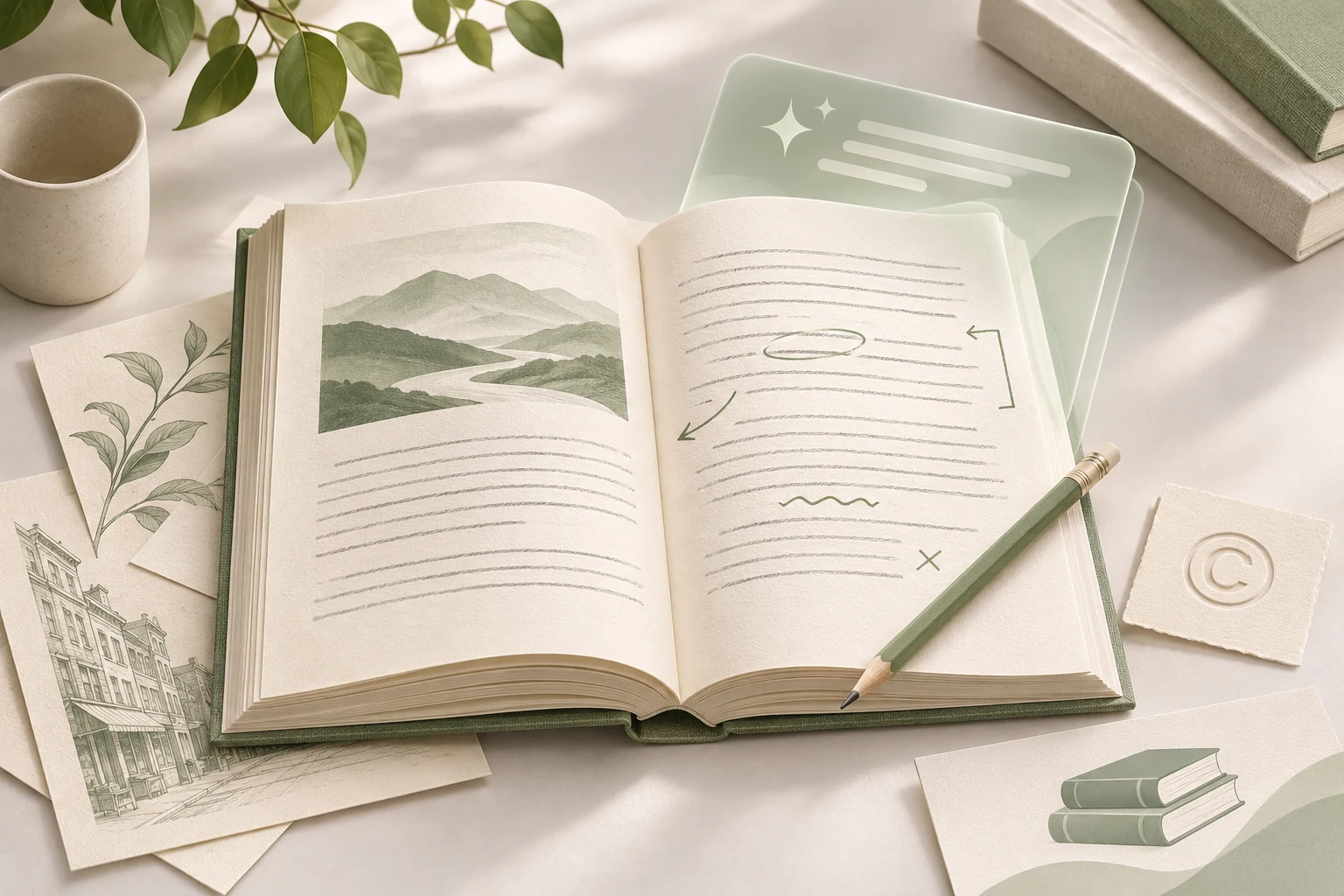
The cover illustration was generated with AI for this article. Its use illustrates the distinction discussed here: permission to use an image and copyright protection for that image are separate questions.